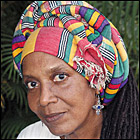
1. How has the media changed since 1968 when you began working in British television?
There are, of course, a lot more brown faces and mixed-up accents on British and world TV. We now have women like Christianne Annampour with international, inter-racial backgrounds. I see a pretty African girl reporting for the BBC in Africa , as well as lots of Asian reporters.
2. What challenges did you face as the first black journalist to appear on British television?
I guess the challenge was 'acceptance,' although I did not know that I was under scrutiny until too late. I just felt it was another job. My former job was a grand one as PR for Jamaican tourism and government in a posh Park Lane PR company that often hosted Arab sheiks. I had no idea that my race and colour would have had such a impact on racist mentalities. I did TV show hosting in Jamaica and had appeared in a British quiz show and another show promoting Jamaica. The racism took me quite by surprise.
3. How much was ethnicity a factor in your career development?
My career developed in Jamaica , where I worked as a journalist on my father's news magazine. In England my ethnicity and the racism it generated was something one simply accepted, having come from a society that at the time accepted the world view that people of my race were 'inferior' to whites.
4. How would you respond to the view that the professional environment of the media prevents many black journalists from sustaining long careers?
I think problems arise when black journalists have to cover negative news about black communities. It's hard not to be considered biased and hard not to be biased. There were also few openings for black journalists when I was in England and few black newspapers to provide a living wage and career. I hope it's changed by now.
5. How might your career have been different if you had started in television journalism 20 years later?
My career would have been much different 20 years later, because the world view has changed and racism is recognised as something bad, rather than something accepted. The world recognises the contribution of black culture much better and don't forget, the white world is reminded more and more of its negative role in the history of black people. Music, Oprah Winfrey, Barack Obama - all have 'upgraded' people's opinion of and attitude to black people.
6. How would you assess the current participation of black and ethnic minorities in the media?
I see US television doing a commendable job of mixing it up among the races and I've already commented on the multi-ethnicity of BBC News reporters.
What I am surprised at though, is that there are so many BBC News programmes and stories about Asia, and even some on Africa, but so very, very few about the Caribbean , whose peoples constitute a large percentage of the current British population. Cuba, which is only 90 miles away from Jamaica, is featured often in news stories, but even our recent and historic elections didn't make it to BBC TV, and there are never, ever feature stories about the region.
7. What role should the media play in promoting diversity and social cohesion?
The media should give more opportunities for diverse peoples to tell their own stories. There should be space and time for this, not just in the form of the media holding up a mike or a camera to newsworthy subjects, but their own stories told by them. 'Slumdog Millionaire' won 8 Oscars because it told someone else's story, a new story never before seen or shown.
8. Should the media act as a 'responsible partner' in an increasingly multicultural environment?
YES, YES, YES. The media must give back to the subjects that fill their air time for free.
9. How would you respond to the complaint that freedom of speech allows extremists too great an access to the media?
That's the price of freedom of speech. You may disagree with what they say but their freedom ensures your own.
10. How would you respond to the complaint that media reporting of ethnic communities remains generally unfavourable?
International media portray Jamaica as (a) tropical paradise, or (b) drug-addicted, violent, dangerous island. Most of the time Jamaica is neither of these but a small heaven on earth, so we often smile or get angry at how we are depicted in these clichés. But I organise an annual festival of films featuring and/or containing reggae music and they show me that if the traditional media is reporting unfavourably about my country, another kind of media is reporting the exact opposite – a more accurate and true picture of life in Jamaica . As the media expands through YouTube, Facebook and other Internet programmes, the work of journalists is taken out of the hands of a few, often prejudiced, hands and expanded into the wider global media community.
This is the future of the media. As a film maker, I do what I can to use film as a true medium of communication. I am inspired by the great Cuban film maker Santiago Alvarez, who first introduced me to the power of the documentary film to convey messages to counteract misinformation. Michael Moore has continued this tradition so expertly, updating the genre in amusing ways.
11. What steps could be taken to encourage more ethnic minorities into the media?
Ethnic minorities should be given access to community cable channels and radio stations to broadcast their own cultural messages. This should be part of the Arts & Culture programmes of all developed nations with large ethnic minorities.
12. What measures still need to be taken by media organisations to adapt to Europe 's multi-cultural environment?
Education through media, especially through film broadcast on TV and the internet, is the best way to encourage acceptance of multiculturalism across Europe . Sadly, European countries will also have to suck the bitter lemon of accepting their historical role in the depressed social and economic conditions of the ethnic minorities. Some will have to apologise for their role in the brutal enslavement of Africans and other forms of genocide and until this is done, the scourge of racism will linger and fester and make its eradication even more difficult.
Barbara Blake Hannah
 Image by Don Hankins via Flickr